Cannock Chase
West Midlands · County constituency · Cannock Chase borough
About the Cannock Chase constituency
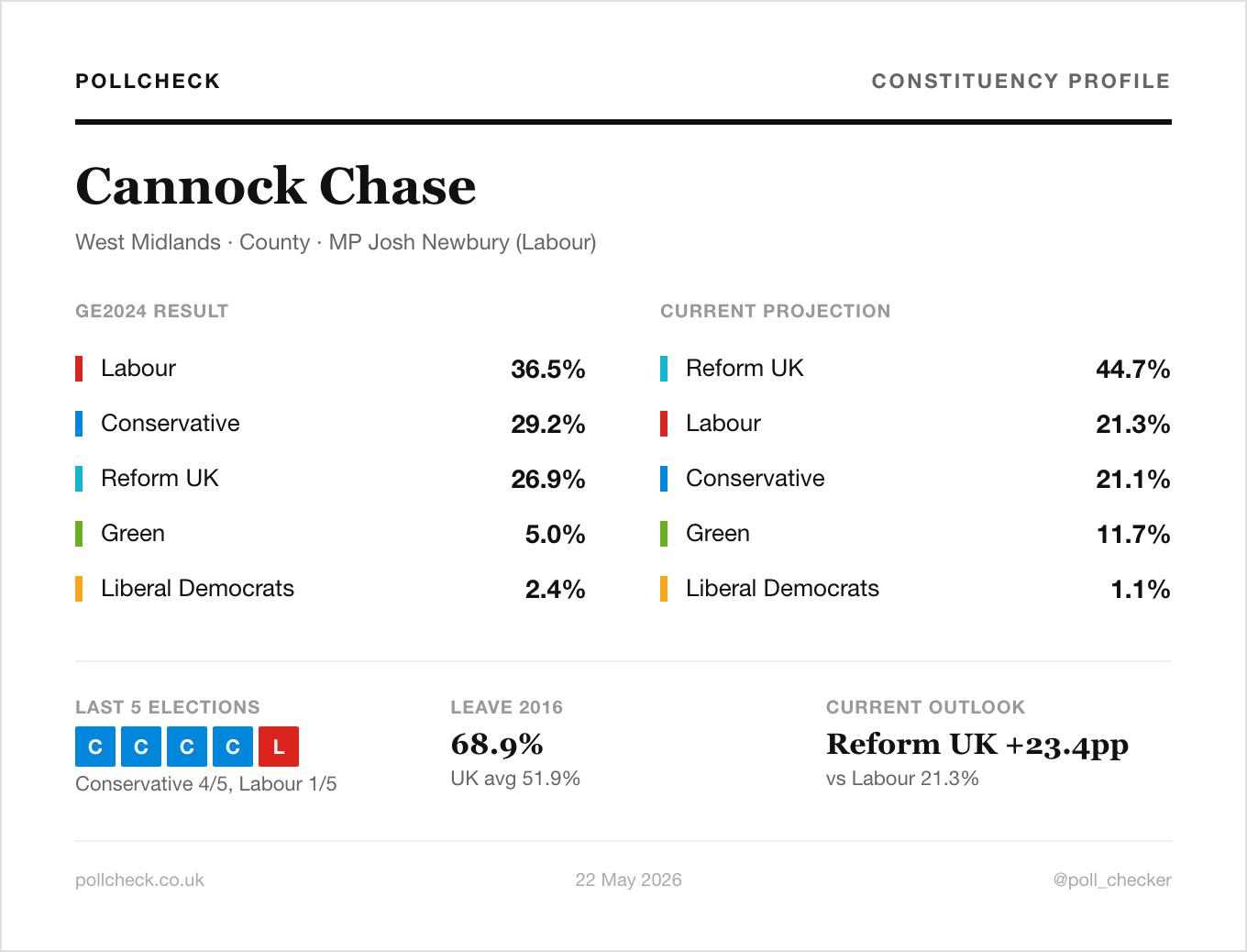
Cannock Chase is a county constituency in the West Midlands. The sitting MP is Josh Newbury (Labour), first elected in July 2024. At the 2024 general election, Labour won with 36.5% to 29.2% for the Conservatives, a majority of 3,125 votes on a 55.8% turnout. PollCheck's current projection, at the seven-poll average, has Reform UK on 40.7% and Labour on 26.4%, a margin of 14.3 points - a projected change of hands from Labour.
Who lives in Cannock Chase? Constituency demographics
From the 2021 Census and 2016 EU referendum estimates. Constituency-level data on 2024 boundaries.
How did Cannock Chase vote in 2024 and how would it vote now?
2024 vote shares from the HoC Library. Current projection is at the 7-poll average.
2024 general election
Current projection
Map of Cannock Chase
Switch between GE2024 ward winners (modelled estimates, ~4pp average error) and a demographic view from the 2021 Census. Hover any area for detail. How the map is built ›
Cannock Chase within Cannock Chase
Cannock Chase sits entirely within Cannock Chase Council. The figures below are from the council elections held on 7 May 2026. About this layer ›
Council overlap
| Council | Share of seat | Projection |
|---|---|---|
| Cannock Chase | 100% | View projection › |
Most recent council ward results
Latest council winner per ward - May 2026 results where the council voted, otherwise the most recent available result. How this table is sourced ›
| Ward | GE2024 winner | Latest council winner | Shift since GE2024 | Turnout |
|---|---|---|---|---|
| Brereton & Ravenhill | Labour 37.6%vs Reform 26.5% | May 2026 Reform 51.3%vs Labour 23.1% | Labour→Reform +19.7pp | 33.1% |
| Etching Hill & the Heath | Conservative 32.8%vs Labour 32.8% | May 2026 Reform 45.6%vs Conservative 29.2% | Conservative→Reform +10.4pp | 37.7% |
| Hawks Green with Rumer Hill | Conservative 35.7%vs Labour 31.1% | May 2026 Reform 50.1%vs Conservative 26.0% | Conservative→Reform +17.0pp | 39.5% |
| Heath Hayes & Wimblebury | Labour 37.9%vs Conservative 30.3% | May 2026 Reform 59.0%vs Conservative 15.6% | Labour→Reform +28.3pp | 37.4% |
| Hednesford Green Heath | Labour 38.6%vs Conservative 32.6% | May 2026 Reform 53.1%vs Green 16.4% | Labour→Reform +28.2pp | 33.6% |
| Hednesford Hills & Rawnsley | Labour 32.0%vs Conservative 28.7% | May 2026 Reform 49.1%vs Green 31.8% | Labour→Reform +25.0pp | 43.4% |
| Norton Canes | Labour 41.6%vs Conservative 29.4% | May 2026 Reform 59.6%vs Labour 16.0% | Labour→Reform +31.1pp | 37.5% |
| Western Springs | Labour 33.9%vs Conservative 30.1% | May 2026 Reform 47.8%vs Conservative 25.8% | Labour→Reform +19.4pp | 38.8% |
Projection trajectory
PollCheck's projection for Cannock Chase at each of the last 60 GB polls. Hover the chart for the underlying poll details.
Who has won Cannock Chase at past general elections?
2024 and notional 2019 rows are on current boundaries; 2010-2017 rows are on the boundaries in force at the time. More on boundaries ›
| Year | Result | MP | Lab | Con | LD | Majority | Turnout |
|---|---|---|---|---|---|---|---|
| 2010 | Con gain from Lab | Aidan Burley | 33.1% | 40.1% | 17.0% | 3,195 | 61.1% |
| 2015 | Con hold | Amanda Milling | 33.7% | 44.2% | 2.7% | 4,923 | 63.2%+2.1 |
| 2017 | Con hold | Amanda Milling | 37.4% | 55.0% | 1.7% | 8,391 | 64.2%+1.0 |
| 2019notional | Conservative winner | Amanda Milling 2019 MP, pre-review boundary | 25.4% | 68.3% | 0.0% | 19,879 | 61.3%-2.9 |
| 2024 | Lab gain from Con | Josh Newbury | 36.5% | 29.2% | 2.4% | 3,125 | 55.8%-5.5 |
Earlier years are on pre-2024 boundaries; comparable results on the new boundary will be added when sourced.
Constituencies most like Cannock Chase
Five seats with similar demographic profiles to Cannock Chase. Politics shown for context.
- ↑Leave68.9 / 70.4vs 53.2
- ↓Graduate22.7 / 22.2vs 33.7
- ↓Private rent15.8 / 15.9vs 20.2
- ↑Leave68.9 / 68.3vs 53.2
- ↓Graduate22.7 / 24.9vs 33.7
- ↑Owner-occupied67.1 / 67.0vs 61.9
- ↑Leave68.9 / 66.0vs 53.2
- ↓Graduate22.7 / 24.9vs 33.7
- ↑Owner-occupied67.1 / 69.0vs 61.9
- ↑Leave68.9 / 70.5vs 53.2
- ↓Graduate22.7 / 20.5vs 33.7
- ↑Owner-occupied67.1 / 66.8vs 61.9
- ↑Leave68.9 / 70.9vs 53.2
- ↓Graduate22.7 / 22.2vs 33.7
- ↑Owner-occupied67.1 / 64.2vs 61.9
What would change this seat?
Move the sliders to set national vote shares. The per-seat projection updates live. Reset returns to the current 7-poll average.
Related
Sources
Every figure on this page is computed from the sources below. Read the full methodology ›
Show full source list
- 2024 general election results · UK Parliament Election Results portal and House of Commons Library briefing CBP-10009.
- Notional 2019 results on 2024 boundaries · UK Parliament Election Results portal. Recalculated by Parliament; carries assumptions about how 2019 voters would have distributed across the redrawn boundaries.
- Historic general election results (2010-2017) · House of Commons Library historic results files (on the boundaries in force at the time).
- Ward-level GE2024 estimates · Britain Elects / New Statesman - article by Ben Walker, underlying spreadsheet. Modelled from constituency totals; average ~4pp per-ward MoE.
- May 2026 council ward results · Democracy Club via PollCheck's locals 2026 dataset.
- Earlier council ward results (2014-2024) · DCLEAPIL v1.0 (Jason Leman, drawing on Andrew Teale's LEAP dataset and Democracy Club).
- Demographics · ONS Census 2021 (England and Wales), aggregated to constituency level using the ONS LSOA21 -> PCON24 best-fit lookup.
- EU referendum 2016 estimates · Constituency-level Leave vote estimates (Hanretty 2017 method).
- MP details and Cabinet roles · UK Parliament Members API. MP photos are fetched live from the same source.
- Boundary geometry and lookups · ONS Open Geography Portal (PCON24 boundaries, LSOA21 boundaries, LSOA21-WD24-LAD24 best-fit lookup).
- Current projection and trajectory · PollCheck's demographic swingometer applied to the rolling 7-poll average from aggregated GB polls. Not a true MRP - vote-share movements are applied through per-constituency sensitivity multipliers derived from demographic regressions.
If you spot a data issue, please let us know.